Traditions
Canboulay: The Cane Fires and the 1881 Riots That Made Carnival
By Soca Carnival EditorsUpdated 7 min read
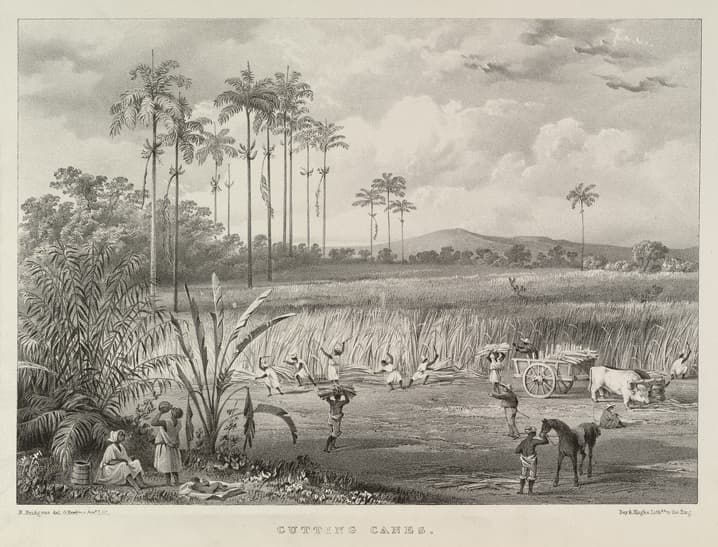
Image credit: Richard Bridgens, via Wikimedia Commons, Public domain
Every year, in the hours before dawn on the Friday before Carnival, flambeaux are lit at Piccadilly Greens in east Port of Spain. Drums start, stickfighters square off, and actors in colonial police uniforms march in to shut the celebration down. They fail, just as they did in 1881. This is the Canboulay Riots re-enactment, and to understand why Trinidad stages it every year, you have to go back to the cane fields.
What Canboulay means
Canboulay comes from the French cannes brûlées, "burnt canes".1 It is now often spelled Kambule or Kanbule, because it has been suggested the word may derive from a Kongo (Congo) term rather than from French.2 Playwright Eintou Pearl Springer, who has shaped the modern re-enactment, renamed her version Kambule in 2010, after the Kikongo word for "procession".3 Both readings tell part of the truth: a French plantation term, carried and remade by Africans.
Fire in the cane fields
During slavery, a fire in the cane fields was an emergency. According to the National Library (NALIS), enslaved people from the surrounding estates were rounded up and marched to the spot to the sound of horns and shells, with drivers cracking whips and urging them, with cries and blows, to harvest the cane before it burned. That event was known as cannes brûlées.4 The National Trust describes gangs marched into the fields carrying flambeaux to douse the fires.5
Before emancipation, the French Creole elite even played at this scene during their own Carnival, dressing up as nègres jardin ("garden negroes", field slaves) and re-enacting the cannes brûlées for fun.4 For the people who had actually lived it, the memory meant something very different.
Freedom, and a festival finds its season
Slavery in the British Caribbean formally ended on 1 August 1834, but most of the formerly enslaved were bound to their former owners under an "apprenticeship" system until full freedom on 1 August 1838.6 With freedom, Africans in Trinidad took the cane-fire memory and turned it inside out.
At first they celebrated the anniversary of emancipation, 1 August, by re-enacting the cannes brûlées, now with masking, dancing, stickfighting, mocking the whites and staging scenes from slavery. After about a decade the celebration moved into the pre-Lenten Carnival season, starting at midnight on the Sunday before Carnival.4 The National Carnival Commission tells the same story: Canboulay "was first played on August 1st, Emancipation Day, but subsequently took place after midnight on Dimanche Gras".7 Folklorist J.D. Elder summed it up as "a ceremony symbolising cane-burning that Africans of Trinidad devised to celebrate their 'freedom from slavery' in 1838."3
NALIS calls this the beginning of the Africans' Carnival.4 It was also, in effect, the start of organised Carnival bands.
Kalinda: the stick and the song
At the heart of the Canboulay was the stick fight, or kalinda (calinda, kalenda). It is a dance as much as a fight, done to drums and chants, probably of African origin. Two fighters at a time, holding sticks about three and a half to four feet long, would take up a guard in the middle of a ring, the gayelle, and try to draw blood.4
The stickfighters were organised into bands, each led by a lead singer called a chantwell (chantuelle or chanteuse) backed by a chorus of women, whose songs egged on their own fighters and insulted the other side. In procession, torchbearers with flambeaux went first, then the batonniers (stickmen), then the king and queen with attendants, supporters, reserve stickmen and the chorus, all marching to kalinda songs with horns, conch shells, rattles and skin drums.4 Those chantwells and their songs are one of the roots of calypso; historian John Cowley's study of the period traces how stickfighting "kalendas" and early calypso grew up together inside Carnival.8
The jamette years
From the 1860s to the 1890s, respectable society called the African-led street festival the "jamette" Carnival. NALIS explains the term as coming from French diamètre, meaning beneath the diameter of respectability. The jamettes were the people of the barrack yards of east Port of Spain: stickfighters, chantwells, sex workers and labourers living in hard conditions, for whom Carnival was a release.4
By the 1870s the Canboulay had become a torchlight procession from midnight on Carnival Sunday, most visible in Port of Spain, with hundreds of men carrying lighted flambeaux and sticks, most of them masked, drumming, singing and sometimes fighting rival bands. Historian Bridget Brereton notes that the authorities found it too wild and too "African", and that lighted torches in a town of wooden buildings gave them a convenient justification for shutting it down.2 Laws passed between 1868 and 1879 gave the police the legal power to act.2
Captain Baker and the 1881 confrontation
The man who decided to act was Captain Arthur Baker, head of the police. At the 1880 Canboulay he called on the marchers to surrender their sticks, drums and torches. Taken by surprise, they did, and Carnival passed quietly.2
They were ready for him in 1881. When Baker and about 150 police moved against the Canboulay bands in the early hours of Carnival Monday, a full-scale fight broke out "involving sticks, batons, stones and fists, NOT guns", in Brereton's words, and 38 of the 150 policemen were injured.2 The National Trust places the clash around Piccadilly Street, with the police engaging the bands as they reached Duke Street.5 Many Canboulay players were hurt too.5
Fearing wider disorder, the Port of Spain Borough Council persuaded Governor Sanford Freeling to confine the police to barracks for the rest of Carnival Monday and all of Tuesday. An effigy of Baker was burned outside the police barracks, and otherwise the two days passed peacefully.2 Freeling addressed the crowd himself and allowed the celebrations to continue;3 NALIS quotes him declaring: "There shall be no interference with your masquerade."4
Interestingly, the island's newspapers took the people's side. Brereton notes that all four local papers condemned Baker as high-handed and provocative, and that the French Creole and mixed-race elites, while no fans of the jamette Carnival, resented the colonial government interfering by force in a festival they saw as core to Trinidad's identity.2
1882 to 1884: proclamation, ordinance and bloodshed in the south
The victory did not last. In 1882 the Canboulay was authorised by proclamation, but with conditions: lit torches only from midnight on Carnival Sunday to 5am on Carnival Monday, and only in open spaces such as the Queen's Park Savannah.5 The authorities also stationed naval ships in the harbour and put troops on alert; in the event, the bands were on their best behaviour and the day passed peacefully.2
The 1883 Carnival was rowdier, with band fights and stoning of houses, and that strengthened Baker's hand. Just before the 1884 Carnival the colony passed the Peace Preservation Ordinance, which authorised banning torchlight processions and large street bands.2 Port of Spain stayed quiet that year, but there was a riot in San Fernando on Carnival Monday morning, an affray in Couva, and in Princes Town more than 500 people resisted the police attempt to stop the Canboulay; police opened fire and two people died.2
After 1884 the Canboulay procession was not revived, and the big stick bands were brought under police control.2 Stickfighting went underground and survived in rural districts from Tunapuna to Sangre Grande and from Freeport to Moruga.4
What Canboulay left behind
The Canboulay did not disappear. It changed shape:
- J'ouvert. With night processions banned, the celebration moved to daybreak on Carnival Monday, and J'ouvert "became well established".4 (See J'ouvert explained.)
- Tamboo bamboo and steelband. With skin drums banned, revellers beat lengths of bamboo instead.4 Around 1935 metal containers began replacing the bamboo, and the steelpan was born.7 Brereton notes that the rivalries of the old stick bands reappeared in the steelbands of the 1940s.2
- Calypso. The chantwell's songs of praise and insult fed directly into the calypso tradition.8 (See from calypso to soca.)
- Traditional mas characters. Devils, stickmen and the defiant spirit of ole mas all carry Canboulay's DNA. (See traditional mas characters.)
Watching the Canboulay Riots re-enactment
The modern re-enactment grew from the work of John Cupid, who began with short Emancipation Day presentations by the Malick Folk Performers in Laventille. Cupid developed the idea with Norvan Fullerton and Tony Hall, whose short first script focused on the street fight and Governor Freeling's speech. In 2004 Eintou Pearl Springer created an extended script, which she revised into a full three-act version and in 2010 renamed Kambule.3 The script has stayed broadly the same over the years, and it remains a staple for Carnival lovers.1
Today it is staged before dawn on Carnival Friday at Piccadilly Greens, organised with the National Carnival Commission. In 2026 it began shortly after 4am on Friday 13 February, with flambeau bearers, drummers, stickfighting, actors playing colonial officers, and an ending that shows the revellers banding together to keep their celebration.9 Over the years the start time has been given as anywhere from 3am to 5am, so check the NCC programme.5,3 For 2027, Carnival Friday falls on 5 February.
Sources
-
Robert Taylor and Jermaine Cruickshank, "Canboulay: the origins of Carnival", Trinidad Express Vibes, February 2026 (opens in a new tab) ↩ ↩2
-
Bridget Brereton, "The Captain and the Canboulay", Trinidad Express, 31 January 2012 (opens in a new tab) ↩ ↩2 ↩3 ↩4 ↩5 ↩6 ↩7 ↩8 ↩9 ↩10 ↩11 ↩12
-
Ray Funk, "Rituals of resistance: the Canboulay Riots re-enactment", Caribbean Beat, issue 108, March/April 2011 (opens in a new tab) ↩ ↩2 ↩3 ↩4 ↩5
-
NALIS, "Mama Dis is Mas" Carnival subject guide (archived copy) (opens in a new tab) ↩ ↩2 ↩3 ↩4 ↩5 ↩6 ↩7 ↩8 ↩9 ↩10 ↩11
-
National Trust of Trinidad and Tobago, "Piccadilly Street" (opens in a new tab) ↩ ↩2 ↩3 ↩4 ↩5
-
UK Parliament, "The West Indian colonies and emancipation" (archived copy) (opens in a new tab) ↩
-
National Carnival Commission, "History of Carnival and its elements" (opens in a new tab) ↩ ↩2
-
John Cowley, Carnival, Canboulay and Calypso: Traditions in the Making (Cambridge University Press, 1996), publisher description via Library of Congress (opens in a new tab) ↩ ↩2
-
Trinidad Guardian, "Canboulay re-enactment ignites city with fire and rhythm", February 2026 (opens in a new tab) ↩
Words from this story
- J'ouvert
The pre-dawn street party that opens Carnival, starting in the dark hours of Carnival Monday (from 4am). Revellers play 'dutty mas' in mud, paint, oil, cocoa, powder and old clothes, chipping through the streets behind music trucks until the sun is up. Traditional characters like blue devils and jab jabs come out too.
- Soca
The high-energy dance music of Carnival, created in the early 1970s by Lord Shorty, who blended calypso with Indian rhythms and instruments such as the dholak and dhantal. Today soca is the soundtrack of fetes, wining and mas.
Frequently asked questions
What does Canboulay mean?
Canboulay comes from the French cannes brûlées, 'burnt canes'. It recalls the slavery-era practice of rounding up enslaved workers to fight cane fires, which freed Africans later turned into a torchlit celebration of freedom.
What happened in the 1881 Canboulay Riots?
In 1881 Port of Spain police under Captain Arthur Baker tried to stop the Canboulay procession. Revellers fought back with sticks, stones and fists, 38 of the 150 policemen were injured, and the police were confined to barracks for the rest of Carnival.
Was Canboulay banned?
Yes. The Peace Preservation Ordinance, passed just before the 1884 Carnival, allowed the authorities to ban torchlight processions and large street bands. The Canboulay was not revived as a street procession after 1884, and its spirit moved into J'ouvert at daybreak.
When and where is the Canboulay Riots re-enactment?
It is held before dawn on Carnival Friday at Piccadilly Greens in east Port of Spain, organised with the National Carnival Commission. In 2026 it began shortly after 4am on Friday 13 February. Carnival Friday in 2027 is 5 February; check the NCC calendar for the confirmed time.
What is kalinda?
Kalinda (also calinda or kalenda) is Trinidad's stickfighting tradition: two fighters with sticks about three and a half to four feet long face off in a ring called a gayelle, urged on by a chantwell and chorus.
Further reading and references
- Bridget Brereton, 'The Captain and the Canboulay', Trinidad Express (2012)
- NALIS, 'Mama Dis is Mas' Carnival subject guide (archived)
- National Trust of Trinidad and Tobago, Piccadilly Street
- Ray Funk, 'Rituals of resistance: the Canboulay Riots re-enactment', Caribbean Beat (2011)
- Trinidad Guardian, 'Canboulay re-enactment ignites city with fire and rhythm' (2026)
- Trinidad Express Vibes, 'Canboulay: the origins of Carnival' (2026)
- UK Parliament, The West Indian colonies and emancipation (archived)
- National Carnival Commission, History of Carnival and its elements
- John Cowley, Carnival, Canboulay and Calypso: Traditions in the Making (Cambridge University Press, 1996), publisher description
Facts last checked 3 October 2026. Read our editorial standards or send a correction.
Keep exploring
- HistoryJ'ouvert in Trinidad: Meaning, History and How to PlayWhat does J'ouvert mean? Trinidad J'ouvert history from Canboulay to mud and paint bands, plus the 2027 date, what to wear, safety tips and road etiquette.Read more
- HistoryThe Origins of Trinidad Carnival: From Plantation Balls to a National FestivalHow Trinidad Carnival began with French Creole planters after the 1783 Cedula of Population, how the formerly enslaved claimed the streets after emancipation, and how it became the national festival run by the NCC.Read more
- HistoryTraditional Mas Characters of Trinidad CarnivalMeet the devils, jesters, robbers and stilt walkers of old-time mas: who the Jab Jab, Dame Lorraine, Midnight Robber, Moko Jumbie and friends are, where they came from, and how to enjoy them today.Read more
- HistoryFrom Calypso to Soca: The Sound of Trinidad CarnivalHow kaiso grew from the chantwell's call into calypso, how Lord Shorty invented soca in the 1970s, and how the Road March, Soca Monarch and stars from Kitchener to Machel shaped the soundtrack of Carnival.Read more
- Timeline1834: Emancipation and the first CanboulaySee where this story sits among the other turning points of Carnival history.Read more
- GlossaryMasShort for masquerade. Mas means the costumed side of Carnival as a whole, from feathered 'pretty mas' bands to traditional characters, and it can also mean a single costume.Read more