Mas
The Evolution of Pretty Mas
By Soca Carnival EditorsUpdated 6 min read
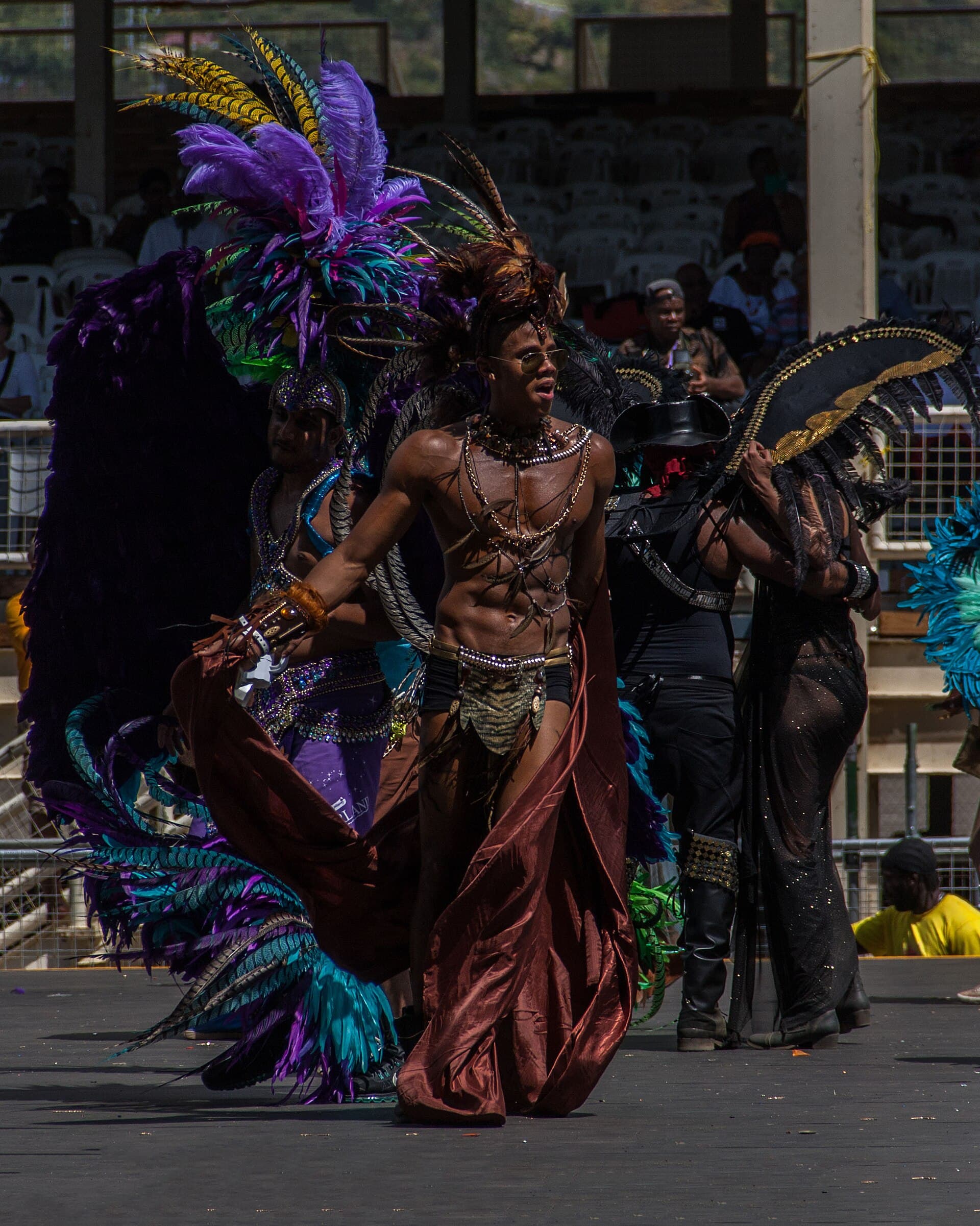
Image credit: Idobi, via Wikimedia Commons, CC BY-SA 4.0
Ask a first-timer to picture Trinidad Carnival and they will probably describe pretty mas: thousands of masqueraders in feathers, beads and colour, dancing behind music trucks on Carnival Monday and Tuesday. Pretty mas is the organised, costumed side of the festival, played in bands made up of sections, each section a variation on the band's theme. But the beaded two-piece is only the latest chapter. For most of the twentieth century, pretty mas meant something closer to open-air theatre, and the bandleaders who built it are some of the most celebrated artists Trinidad has produced.
The historians
In the years after the Second World War, the most prestigious bands were "historical" mas: meticulously researched portrayals of empires, armies and ancient worlds.
The master of the form was Harold Saldenah, born in Belmont in 1925 and known to everyone as "Sally". He designed his first band in 1952, inspired by the film Quo Vadis. In 1955 he presented Imperial Rome 44 BC to 96 AD, with centurions, gladiators and vestal virgins, and won the first of his six Band of the Year titles.1 His insistence on accuracy famously put his Roman soldiers into short skirts, and he brought in craftsman Ken Morris to make tooled leather and copper breastplates, adding metalwork to the language of mas.1
Saldenah also developed "section mas" in the 1960s, dividing a large band into themed sections, each with its own flag bearer and title, that came together to tell a bigger story.1 Bands on the road today are still organised in sections, so every time you choose a section you are using Sally's idea.
George Bailey and the meaning of Africa
George Bailey produced his first band in 1956, out of a mas camp on Buller Street in Woodbrook, when he was just 20. The following year he presented Back to Africa and won Band of the Year.2
It was a turning point. Before Bailey, crowds did not believe an African portrayal could match the grandeur of Rome or Greece. His richly researched costumes showed Africa as regal and magnificent, and he proved the doubters wrong.2 Bailey won Band of the Year six times, including Relics of Egypt, Byzantine Glory and Bright Africa, and he won the popular affection of ordinary spectators like few designers before or since. He died of heart failure in 1970.2
The Harts and the rise of fun
Not every bandleader wanted a history lesson. From 1962, Edmond and Lil Hart built bands around abundant colour and simple costuming that people from every part of society could afford and enjoy, winning Band of the Year with presentations such as Playing Cards (1966) and Islands in the Sun (1986).3 "We are masqueraders first, and anything else after," Edmond Hart said. "We look for a simple costume and have fun."3
In the 1980s the Harts were among the first bands to introduce special sections for "body beautifuls". Edmond said they tried to be as conservative as possible, while accepting that masqueraders would modify their costumes as they pleased.3 In hindsight, those sections point straight towards the modern costume. In 1992 three of their children formed Young Harts, later simply Harts, which became one of the most successful bands of the modern era.3
Wayne Berkeley and fantasy mas
Wayne Berkeley, born in 1940, grew up on Clifford Street in Belmont, opposite Saldenah's mas camp. In 1965 he designed his first full band, Fan Fair, for bandleaders Jean Antoni and Geoff Inglefield. It was one of the first major examples of fantasy mas, springing from the designer's imagination rather than a history book, and it helped start the trend that within a few years brought the historical genre to an end.4 His bands were known for well-conceived themes, meticulous craftsmanship and a theatrical polish compared to Broadway, built with worksheets and prototypes and with inventive materials such as wrapped crepe paper for feathers and bundled drinking straws for stars.4
Berkeley won Band of the Year 11 times, including six in a row from 1989 to 1994.4 He also understood the other side of the job: "Producing a successful masquerade band is a combination of both artistry and business."5
Peter Minshall, the dramatist
Peter Minshall, born in 1941 in what was then British Guiana and raised in Trinidad, trained at the Central School of Art and Design in London. In 1976 he designed Paradise Lost for bandleader Stephen Lee Heung, with around 1,500 masqueraders, and it won Band of the Year, beginning what Caribbean Beat calls the "Minshall era".6
Minshall treated mas as street theatre on an epic scale. In 1983 he began a trilogy with River, whose Washerwoman queen and Mancrab king are still talked about, followed by Callaloo (1984) and The Golden Calabash (1985). His Band of the Year winners include Carnival of the Sea (1979), Jungle Fever (1981), Carnival Is Colour (1987), Hallelujah (1995), Song of the Earth (1996) and Tapestry (1997).6 His own description of the work says it best: "I don't design costumes. I provide the means for the human body to express its energy."6
Bikinis, beads and the all-inclusive
Through the 1990s and into the new century, "bikini mas" became the dominant look on the road. Writing in 2004, Caribbean Beat described the new costume formula as a few square inches of spandex, festoons of beads, loops of braid and a feather or two, repeated in dozens of colour variations.5
At the same time the business model changed. Masqueraders were now paying not only for a costume but for security guards, drinks carts and marketing.5 The band most associated with that shift is Tribe. It was founded by Dean Ackin, his wife Monique Nobriega and her sister Lana, when masqueraders persuaded them to turn their popular section of the band Poison into a standalone band. SocaNews credits Tribe with introducing the all-inclusive concept to mas, as well as the mobile bar.7 By 2018 the Tribe group ran six bands: Tribe, Bliss, The Lost Tribe, Pure, Harts and Rogue.7
For masqueraders, the all-inclusive model means one price that covers costume, food, drinks, security and facilities on the road. For many visitors it is the easiest way to play mas for the first time.
Art or commerce?
Not everyone celebrated the change. The same Caribbean Beat feature argued that market forces had tipped the balance away from artistry towards profit margins and assembly-line production, and warned of a gradual "re-segregation of the mas, along strictly economic lines", with ropes and security keeping non-paying revellers out.5
Defenders of modern mas point out that the big bands put thousands of people on the road, sustain a year-round costume industry and make Carnival accessible to visitors who could never build a costume themselves. Critics answer that a band of identical bikinis tells no story. The debate is far from settled, and you will hear it argued in rum shops, on talk radio and on social media every Ash Wednesday.
Band of the Year today
The competition that Saldenah, Bailey, Berkeley and Minshall fought over still runs today. The National Carnival Commission names its Band of the Year, and separate committees judge bands at points uptown and downtown.
At Carnival 2026, The Lost Tribe swept the major titles with Island Circus, taking the NCC's Large Band of the Year and overall Band of the Year, its fifth Large Band crown and fourth in a row.8 9 Trinidad All Stars, portraying Sailors Ashore in Japan, placed second in the Uptown Carnival Improvement Committee's large band judging, just two points behind.9 In other words, the modern all-inclusive and the old sailor tradition finished almost side by side, which is a neat summary of pretty mas in the twenty-first century.
Sources
-
Caribbean Beat: Harold Saldenah, the historian (opens in a new tab) ↩ ↩2 ↩3
-
Caribbean Beat: George Bailey, the monarch (opens in a new tab) ↩ ↩2 ↩3
-
Caribbean Beat: The fun-lovers, Edmond and Lil Hart (opens in a new tab) ↩ ↩2 ↩3 ↩4
-
Caribbean Beat: Wayne Berkeley, the showman (opens in a new tab) ↩ ↩2 ↩3
-
Caribbean Beat: Bikinis, beads, braids (opens in a new tab) ↩ ↩2 ↩3 ↩4
-
Caribbean Beat: Peter Minshall, born 1941 (opens in a new tab) ↩ ↩2 ↩3
-
SocaNews: Dean Ackin focused on brand T&T as Tribe turns 15 (opens in a new tab) ↩ ↩2
-
TTT: Five and counting, The Lost Tribe reigns again as Senior Large Band of the Year (opens in a new tab) ↩
-
Trinidad Guardian: Lost Tribe cops 2026 triple crown (opens in a new tab) ↩ ↩2
Words from this story
- Mas
Short for masquerade. Mas means the costumed side of Carnival as a whole, from feathered 'pretty mas' bands to traditional characters, and it can also mean a single costume.
- Mas camp
The home base and workshop of a mas band, where costumes are designed, built and assembled.
- Callaloo
A thick green soup made from dasheen leaves, coconut milk, ochroes (okra) and pumpkin, sometimes with salted meat or crab.
Frequently asked questions
What is pretty mas?
Pretty mas is the costumed parade side of Carnival on Monday and Tuesday, played in organised bands divided into sections, as opposed to the rough, messy fun of J'ouvert or the satirical characters of traditional mas. It ranges from large theatrical portrayals to the bikini, beads and feathers costumes most visitors picture today.
What is an all-inclusive mas band?
An all-inclusive band sells one package that covers your costume plus drinks, food, security and facilities on the road for Carnival Monday and Tuesday. Tribe, which grew out of a popular section of the band Poison in the early 2000s, is widely credited with pioneering the model.
Who won Band of the Year in 2026?
The Lost Tribe won the National Carnival Commission's Large Band of the Year and overall Band of the Year for Carnival 2026 with its presentation Island Circus, its fifth Large Band title and fourth in a row.
Who was Peter Minshall?
Peter Minshall is a Trinidad mas designer, born in 1941, whose bands turned Carnival into large-scale street theatre. His work includes Paradise Lost (1976), the River trilogy beginning in 1983 and Band of the Year winners such as Carnival Is Colour (1987), Hallelujah (1995), Song of the Earth (1996) and Tapestry (1997).
Further reading and references
- Caribbean Beat Issue 65: Trinidad Carnival's artists of the streets (2004)
- Caribbean Beat: Harold Saldenah, the historian
- Caribbean Beat: George Bailey, the monarch
- Caribbean Beat: Wayne Berkeley, the showman
- Caribbean Beat: Peter Minshall, born 1941
- Caribbean Beat: Bikinis, beads, braids
- SocaNews: Dean Ackin focused on brand T&T as Tribe turns 15
- Trinidad Guardian: Lost Tribe cops 2026 triple crown
Facts last checked 3 October 2026. Read our editorial standards or send a correction.
Keep exploring
- HistoryTraditional Mas Characters of Trinidad CarnivalMeet the devils, jesters, robbers and stilt walkers of old-time mas: who the Jab Jab, Dame Lorraine, Midnight Robber, Moko Jumbie and friends are, where they came from, and how to enjoy them today.Read more
- HistoryThe Origins of Trinidad Carnival: From Plantation Balls to a National FestivalHow Trinidad Carnival began with French Creole planters after the 1783 Cedula of Population, how the formerly enslaved claimed the streets after emancipation, and how it became the national festival run by the NCC.Read more
- HistoryFrom Calypso to Soca: The Sound of Trinidad CarnivalHow kaiso grew from the chantwell's call into calypso, how Lord Shorty invented soca in the 1970s, and how the Road March, Soca Monarch and stars from Kitchener to Machel shaped the soundtrack of Carnival.Read more
- HistoryJ'ouvert in Trinidad: Meaning, History and How to PlayWhat does J'ouvert mean? Trinidad J'ouvert history from Canboulay to mud and paint bands, plus the 2027 date, what to wear, safety tips and road etiquette.Read more
- Timeline1955: Saldenah's Imperial RomeSee where this story sits among the other turning points of Carnival history.Read more
- EventCarnival Tuesday 2027: Parade of the BandsTuesday 9 February 2027 is the big day: full pretty mas costumes, judging points and thousands of masqueraders crossing Port of Spain in the Parade of the Bands, the last day before Ash Wednesday.Read more